
Premise
Given that the sanctuaries of San Michele are beautiful and stupendous and I would like to see them all in my life sooner or later and that I have nothing against those who are faithful to San Michele, I asked myself:
Are there really 7 shrines in a straight line?
Yesterday I came across a post which says that there are 7 shrines in a straight line that ideally point to Jerusalem … Well what about .. wow … but is it really true? 🙂
We start from the presumption of saying that the earth is not flat … and therefore, on the earth, there are no straight lines, but geodic curves. Having said this already in the title we find the first big mistake. Error that should make us understand that we are reading something at least doubtful. I understand that at the time of the birth of the cult of Archangel Michael, perhaps, there was still no evidence of the sphericity of the earth.
How do you get a straight line on a sphere?
While in 2020 when I read this article, it should be clear to everyone that the earth is spherical and that the lines on a sphere do not exist, I believe that this concept is explained in elementary school, a degree course is not needed.
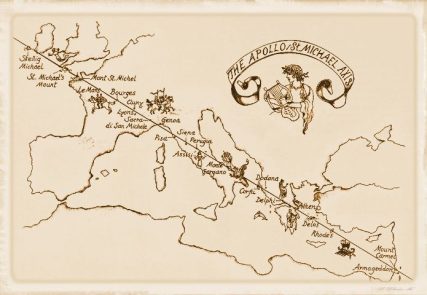
Second: even if in the article a photograph of an ancient map appears, representing Europe called The Apollo / St. Michael Axis, it is perfectly understood that this representation is absolutely not to scale nor does it have a projection, and neither is it so ancient …, whereby we can fall into any curved line that ideally connects anything, just move the cities slightly and it’s quickly done.
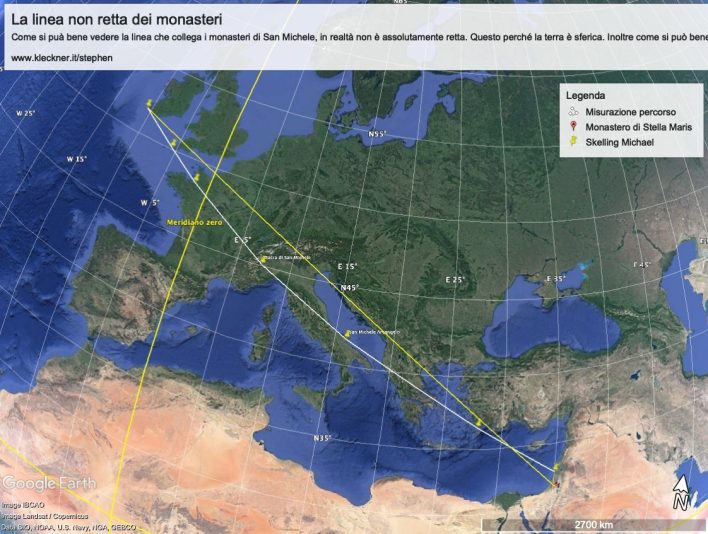
Third, there is a great tool, which not everyone knows how to use, but many children or teenagers use to virtually fly or explore unknown places. This elusive tool is called Google Earth, there is also the PRO version. Well, if you had the patience to place points on all the sanctuaries, which should be positioned on this phantom line and try to connect them with the line tool, you would realize that, being the earth spherical, they are not on a straight line. , which as we said before, does not exist, but are positioned on an arch. I did it for you and here is the result .. 🙂
The sanctuaries of the line of San Michele are not in line, indeed there is a difference of 900 km
As you can see, the 7 sanctuaries, which are not equidistant from each other, do not lie on a straight line, even if a projection is performed on a plane representation.
“But Stephen …! It’s obvious it’s on a piece of paper, it’s obvious it’s a straight line …!” Well what can I say, do a review of cartography and goniometry, I highly recommend it unless you are flat-earthers and if so I raise my hands …
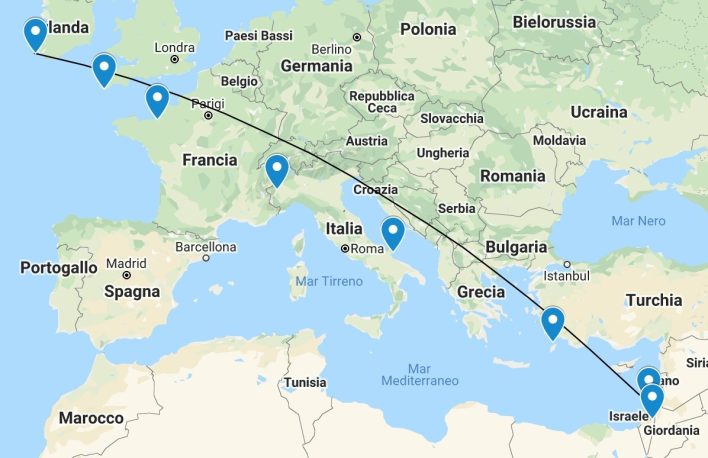
Let’s get back to us … if it were on a flat projection, well done, like that of Google Maps, “aligning” the first three sanctuaries and extending the line that would become curved, because I repeat a straight line cannot be, the extension would pass to 68 Km south of the Sacra di San Michele in Val Susa and this is enough to dispel the “straight line of San Michele” but let’s try to do them all … and we would arrive at a distance of well over 900 km from Jerusalem … in short, there it’s something wrong said the little round man who lived in the round house putting the round key in the lock of the round car that didn’t light up … 🙂
As you can see from the map below made with Google My Maps that follows a cylindrical centrographic projection of Mercator, the one we are used to looking at the maps stuck in the elementary classrooms to be clear, it is likely that we can draw a straight line between the points, which in reality is not straight, however, but if we wanted to draw a straight line, between the two sanctuaries at the ends, those of Skelling Island in Ireland and that of Mount Carmel, it would necessarily become an arc, always for the same discourse of the sphericity of the earth, written before .
The line of San Michele does not exist
As you can see, already aligning the first 3 sanctuaries, if extended the line would reach well over 900 km from Jerusalem, which is exactly south of Haifa and not ideally …
In short, this phantom line that would connect all the sanctuaries does not exist, even with some discrepancies or errors … unfortunately it is clearly an invention. In addition to the fact that in Europe and in the Arabian peninsula there are a number of temples and monasteries so dense that you can connect with approximately any type of line anything you want.
If you want to find a coincidence you will find it, but it is always better to find the truth than a non-truth in a coincidence.
Sources
There are also some scholars who talk about this in a much more exhaustive and scientific way than me, in addition to some sites that I report below:
St. Michael Alignment is England’s Most Famous Ley Line. But is it Real?
Saint Michael’l line on Wikipedia
La sacra linea di San Michele e la TAV
Proiezione cilindrica centrografica di Mercatore

Wow Stephen you could suck the wonder out of any mystery, fun out of any story, curiosity out of the cat but hey you’ve got passion for Lego so good for you
Hi Stephen,
I’m working on a television documentary on the St. Michael Line. Last summer I traveled to all 7 (actually there are more than 7) and interviewed a few historians and archaeologists et al about the issue. You are correct, using a sphere (e.g. Google Earth Pro) we do not have a straight line. But using the Mercator projection of the globe used by mariners at the time the monasteries were constructed (except for Taxiarchis on Symi) the line only deviates by about a degree, depending on how you establish the baseline. (…and Jerusalem is not on the line) That is, if you use the basis for geography at the time the monasteries were built, the line is straight. However, the “straightness” of the line or if the line describes the circumference of a circle, is of less importance (although it is an attraction) than what the alignment could mean. That’s what I’m working on. I just don’t think they have to be a straight line of a sphere to make sense or have meaning. And while I do take liberty with the “straightness” the alignment (even when considering the Apollo sites for which there is a parallel between St. Michael and Apollo as both are “gods” of war, if you will, the meaning of the sword of St. Michael could be what I suggest at the end of my Field Report 20 found on this page: https://stanwilliams.com/ANGELQUEST/FieldReports.html