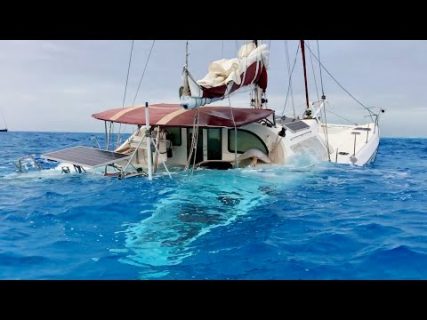
Fuel is essential…!
When you go to sea, especially on a motorboat or a sailboat, you are not driving a car on land…, you cannot think as if there were a fuel station in every small bay, so this is how I reason…:
Assuming a 100-liter tank, just to keep calculations simple from the start… and an engine that consumes 5.6 liters/hour at a speed of 7 knots, which corresponds to 7 nautical miles per hour as average cruising speed (considering there is always a small current of about 0.5 knots)…
If we divide: 100 liters by 5.6 liters/hour, we get about 17.85 hours of engine autonomy… which at 7 knots gives exactly 125 nautical miles of maximum range.
Never use maximum range!
Using maximum range is wrong and also prohibited by navigation regulations, which require considering a 30% reserve… and we cannot reason this way… for a number of different reasons:
- There could be stronger current or headwind against the boat, meaning you must fight it, which could reduce your speed by up to 3 knots, lowering your cruising speed to 4 knots without changing fuel consumption.
- You are navigating through two fluids: wind acting on the above-water structure and water acting on the hull.
- Sea and weather conditions may become much more severe and you may be forced to tack under engine power to face waves on the bow.
- There may be a change of plans due to an incoming storm, or the need to return to port due to a crew member’s illness, or the need to tow a sailboat for a long distance or assist a vessel in distress…
- You may have a small leak in the diesel tank, or contaminate part of your fuel, hoping the tanks are separated so you can isolate the clean fuel.
- You may have taken on dirty diesel or stirred up sludge due to rolling, especially in rough seas or storms.
Always keep a reserve!
When you get your boating license, they teach you to calculate autonomy using only 70% of the tank for a very specific reason: you must ALWAYS consider a RESERVE…!
So 30% of your ideal 100-liter tank means 30 liters that must never be used… with which at 7 knots you can travel 87.5 nautical miles.
At this point I go even further:
I consider 30% of the remaining 70 liters (therefore excluding the main reserve, which I do not intend to use). The liters available for route calculations drop to just 49 liters (half the tank), which at 7 knots give 8.75 hours of autonomy, for a range of 61.25 nautical miles…
Consumption and range table
| LT | Kn | LT/h | h | Miles | ||
| Tank capacity | 100 | 7 | 5.6 | 17.9 | 125 | |
| Tank capacity at 4 Kn | 100 | 4 | 5.6 | 17.9 | 71.4 | |
| Considering 30% reserve | 70 | 7 | 5.6 | 12.5 | 87.5 | |
| Considering 30% of the remaining 70% | 49 | 7 | 5.6 | 8.8 | 61.25 | |
| Maximum usable reserve | 51 | 7 | 5.6 | 9.1 | 63.75 | |
| With one 20L jerry can added (after reserve) | 69 | 7 | 5.6 | 12.3 | 86.25 | |
| With two 20L jerry cans added (after reserve) | 109 | 7 | 5.6 | 19.5 | 136.25 | |
Note how your reserve increases when adding two 20L jerry cans.
You may say I’m exaggerating…!
Yes, it’s true…! I have sailed with people who now even run sailing academies and have run out of fuel multiple times, or who failed to realize that the main tank valve was closed.
With this approach, I am always confident that whatever happens within about 60 miles, I still have a safe option to reach a port for refueling depending on my draft.
I am also prepared for rough seas or sudden changes of plan. Yes, this means always sailing with half a tank, which adds weight and increases consumption, but I prefer it this way… I can still travel another 63.75 miles to reach a port. Changes of plan are far more common than people think; it only takes a small accident.
It often happens that refueling is not possible in certain ports due to insufficient depth, tides, overcrowding (especially in summer in the islands), or lack of fuel at the station.
This method gives you a much more realistic idea of the fuel on board and especially the maximum reachable distance to ports where you can refuel, in relation to your draft, boat size, fuel capacity, and consumption.
Always carry jerry cans
Always carry at least two 20L fuel jerry cans so you can refill and increase your range. It can be essential to have empty cans to receive emergency fuel from a fishing boat. It has happened to me twice.
This means that once you reach half your tank, if you encounter rough seas and need to navigate for a long time, you could run out of fuel.
For route planning, I always use these parameters, meaning I plan for a maximum of 8 hours of navigation and ensure refueling within a 60-mile range. Because if the sea gets rough, you won’t be doing 6 knots at 2200 RPM anymore, but 4 or less — fighting waves can triple your navigation time. Remember this.
Be careful not to run out of fuel at the harbor entrance
I remember more than once running out of fuel with different boat owners during offshore passages to Greece or southern Italy. Fuel is essential: it is your lifeline. It powers propulsion, onboard systems, and safety equipment. You can even use it for heating with a Webasto system if installed — it is your survival.
If you run out of fuel at the harbor entrance with strong wind and heavy seas, you could lose your life, crashing the boat against the rocks — and unfortunately, this has already happened.
Articoli collegati